
6 steps to take backup of all the objects from 'user' layer

While working on client side with lot of customizations, someone must take the backup of all the changes which already have done in an application.

A very short way of taking backup from a selected layer is as follows;

1. Create a new project and open it.
2. Click on the Advance filter/Sort for this project, it will open the following screen
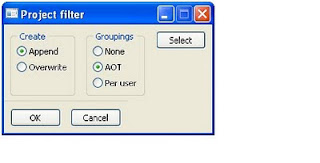

Note: Make sure the above options should be selected for this scenario.

3. Click on ‘Select’ button.
4. Remove all the ranges from this query form and add only one range. The form will now looks like this;
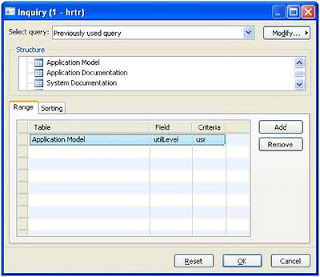


5. Press OK, form will be closed
6. Press OK

The new project will contains the entire objects, group by their consecutive groups.

Comments

Popular posts from this blog

D365O - How to add financial dimension in grid

This post outlines the steps; how to add financial dimensions (segmented control) in a grid in D365O. Let's assume we are adding new table and form for below explanation; New table contains two fields  AccountType and  LedgerDimension with relation to DimensionAttributeValueCombination table  Form looks like this; Set properties for segmented control under form design; - Auto declaration = Yes - Account type field = AccountType - Controller class = DimensionDynamicAccountController - Filter expression = %1 1. Override modified method for LedgerDimension field under form's datasource 2. Override lookup and checkUserCustomLookup method on ledger dimension segmented control in form desgin Datasource | D365O_FinancialDimension | LedgerDimension | modified [DataSource]     class D365O_FinancialDimension     { ...

The Dual Write implementation - Part 1 - Understand and Setup

What is Dual-write? Tightly couples – complete at one transaction level Near real time Bi-directional Master data and business documents – Customer records you are creating and modifying and at this document we are talking about sales orders or quotes and invoice. Master data could be reference data e.g. customer groups and tax information Why Dual-write and why not Data Integrator? Data Integrator is Manual or Scheduled One directional Now, Let's deep dive and understand what is required for Dual-write setup and from where to start. First thing first, check you have access to https://make.powerapps.com/ Choose right environment of CDS (CE) Make sure you have access to the environment too, click on gear icon and Admin Center  Look for required environment and Open it, you must have access as going forward you are going to configure dual write steps in the environment user the same user you are logged in now. Now, go back to power platform admin center and...

Another step closer - Finance Operations data in Power Platform - Virtual Entities

This post focuses on the integration technologies available to have the Microsoft Dynamics 365 Finance Operations data available in Dataverse/Common Data Services/CDS. What could be better then having The biggest ERP system's data in Power Platform. You can Power Portals, Power Apps, Power BI analytical reports, use power virtual agents for inventory closing and year end closing processes, manage expenses and employee/contractors time entry processes, most of these processes can be even without logging to MS ERP (Dynamics 365 Finance Operation) so can safe on license cost too.  Let's see what options are available to integrate F&O data with Power Platform however, this post is dedicated to Virtual Entities.  3 Options available out-the-box to integrate F&O data with Power Platform; 👉  Data Integrator  - Click on link to read more 👉  Dual-Write  -  Click on link to read more 👉  Virtual Entities - MS Tech Talk on Virtual entities   ...